

Car Security System Market Share to Grow CAGR of 8.20%, Technology, Trends, Demands, and Global Outlook To 2035
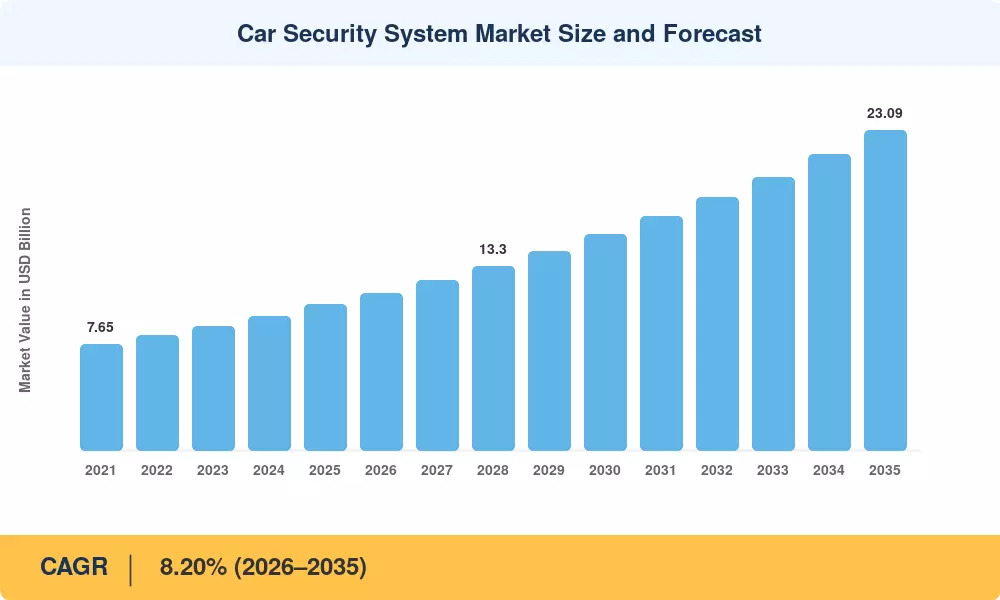
Car Security System Market Summary
North America generated USD 3.68 billion in 2025, with for 82%. Asia-Pacific to reach USD 7.62 billion by 2035, contributing over 70% of regional demand.
Immobilizer systems lead the Car Security System Market with an estimated 32% revenue share in 2025, underpinned by regulatory mandates in 40+ countries.”
NY, CA, UNITED STATES, July 14, 2026 /EINPresswire.com/ -- A car security system is an integrated network of hardware and software components designed to enhance vehicle safety by preventing unauthorized access, use, or theft . These systems range from basic mechanical locking mechanisms to sophisticated electronic modules that include remote locking, audible alarms, steering wheel locks, engine immobilizers, real-time telematics, GPS tracking, and smartphone-integrated digital keys . Modern systems are increasingly connected to cloud-based platforms and mobile applications, allowing owners to remotely monitor and manage their vehicle's security status in real time . The architecture spans factory-installed OEM solutions and aftermarket retrofit devices, providing protection across the entire vehicle lifecycle.— Arti Dhapte
Car Security System Market Overview
The car security system market share is positioned for robust growth through 2035, driven by rising global vehicle theft rates, regulatory mandates, and the accelerating transition to connected, electric, and autonomous vehicles. The projected valuation of USD 23.09 billion, growing at a CAGR of 8.20%, reflects the evolution of vehicle security from standalone hardware into integrated digital platforms tied to over-the-air update ecosystems.
The market is experiencing robust growth driven by several fundamental factors. Rising global vehicle theft rates are the primary catalyst—the FBI's 2024 Uniform Crime Report documented over 1.02 million motor vehicle thefts in the United States alone , with a vehicle stolen every 37 seconds . In the UK, approximately 133,000 vehicle thefts were reported in 2024, with London logging 34,000 instances—one theft for every 88 vehicles . Regulatory mandates for electronic immobilizers across Europe and tightening insurance requirements continue to push OEMs toward embedding multi-layer security architectures into every new vehicle . The rise of connected vehicles and digital key technologies, along with the growing sophistication of theft methods such as relay attacks and CAN-bus hacking, are compelling both automakers and consumers to prioritize advanced protection systems .
Industry trends indicate a decisive shift from traditional mechanical locks and basic alarm sirens toward connected, software-defined security platforms. Automakers invested more than USD 3.8 billion in connected-vehicle cybersecurity and digital key infrastructure during 2024 . The transition to ultra-wideband (UWB) relay-attack-resistant entry systems, AI-powered anomaly detection on the CAN bus, and biometric authentication methods is accelerating across every vehicle segment . The integration of artificial intelligence for real-time threat detection and predictive theft prevention is becoming standard in premium vehicles, with machine learning models trained on telematics data and driver-behavior patterns enabling proactive risk assessment .
Technological developments are advancing rapidly. Ultra-wideband technology measures precise distance between key and vehicle, making relay-amplification attacks nearly impossible—the primary exploit in over 90% of keyless-entry thefts . Biometric authentication methods, including fingerprint and facial recognition systems, are gradually replacing conventional key-based access . The UNECE has established comprehensive requirements for digital keys under UN Regulation No. 116, mandating authorization and revocation processes, boundary of functional operation limits, and compliance with cybersecurity standards . In-vehicle AI processors now analyze CAN-bus anomalies and camera feeds locally, enabling sub-second intrusion response without cloud latency .
Policy and regulatory influence on the car security system market is profound. UNECE Regulation No. 116 requires electronic immobilizers as standard equipment in all new passenger cars supplied to 54 contracting parties . The EU Cyber Resilience Act expanded these criteria to include software-defined security updates starting in July 2024 . India's AIS-037 standard mandates speed-sensing door locks and central locking on all cars above specific price points . In the US, proposed NHTSA rulemaking (FMVSS No. 150 draft) would require multi-layer intrusion detection and incident-response capabilities for all SAE Level 3+ vehicles by 2030 . These regulatory floors establish minimum technical requirements and ensure baseline demand across global markets.
The demand outlook remains strongly positive. North America commands approximately 35% of the global market, bolstered by high vehicle penetration and stringent insurance mandates . Asia-Pacific is the fastest-growing region with an anticipated CAGR of 10.40%, driven by surging automobile production in China and India and rising consumer awareness in densely populated cities . The passenger vehicle segment holds approximately 72% of market revenue, reflecting higher per-unit security feature adoption . Electric vehicles present new security challenges—EVs are increasingly targeted by thieves for parts and resale, with some stolen in under two minutes using cyber tools . The transition to electric and autonomous vehicles expands the addressable security market, as these platforms rely heavily on software and connectivity, creating complex new attack surfaces .
📍 Get Free Sample Report for Detailed Market Insights:
https://www.marketresearchfuture.com/sample_request/29951
Car Security System Market Segmentation
By Product Type
The car security system market is segmented by product type into Immobilizer Systems, Alarm Systems, Central Locking Systems, Remote Keyless Entry Systems, Steering & Gear Locks, and Others. Immobilizer systems lead the market with an estimated 32% revenue share in 2025, underpinned by regulatory mandates in 40+ countries . The technology has evolved from simple transponder-chip validation to rolling-code encryption and cloud-verified authentication, creating recurring software-licensing revenue for OEMs . Modern immobilizers increasingly incorporate RFID technology, encrypted electronic control units, and smartphone-based authentication methods . Alarm systems accounted for USD 2.25 billion in 2025, sustained by aftermarket retrofit demand in emerging economies . Central locking systems are forecast to register the fastest CAGR of 9.80% through 2035, driven by integration with smartphone-based digital key platforms . Remote keyless entry systems hold 18% market share, with consumer convenience driving adoption of UWB anti-relay technology . Steering and gear locks represent USD 0.62 billion in 2025, serving budget-conscious markets as a physical deterrent layer .
By Vehicle Type
Vehicle type segmentation includes Passenger Cars, Light Commercial Vehicles, and Heavy Commercial Vehicles. Passenger cars represent 72% of total market revenue, reflecting higher per-unit security feature adoption driven by consumer demand, insurance mandates, and OEM bundling strategies . The segment holds approximately 76% of the vehicle anti-theft system market . Passenger vehicles are increasingly equipped with factory-installed digital keys, immobilizers, and biometric access technologies . Light commercial vehicles are growing at a CAGR of 8.60%, fueled by last-mile delivery fleet security investments . Heavy commercial vehicles are expected to grow at a CAGR of 9.10%, driven by cargo protection needs and telematics integration .
By Sales Channel
Sales channel segmentation includes OEM and Aftermarket. The OEM channel leads with 58% market share, as regulatory mandates guarantee factory-installed immobilizers, central locking, and keyless entry across new vehicles . OEMs are increasingly collaborating with technology providers to embed systems like biometric authentication, encrypted key fobs, and connected vehicle security solutions during manufacturing . The aftermarket channel is growing at a CAGR of 9.30%, driven by retrofit demand in regions where new-vehicle turnover is slow and theft rates remain elevated . With over 1.4 billion vehicles in the global parc—most lacking advanced security features—the aftermarket opportunity remains vast, particularly in Asia-Pacific, South America, and Africa . Affordable tracking devices and SIM-enabled alarm modules priced under USD 50 are unlocking volume in emerging markets .
By Region
Regional segmentation includes North America, Europe, Asia-Pacific, South America, and the Middle East and Africa. North America generated USD 3.68 billion in 2025, with the US accounting for 82% of regional revenue . Asia-Pacific is expected to reach USD 7.62 billion by 2035, with China and India contributing over 70% of regional demand . Europe's market benefits from EU R116 immobilizer type-approval rules, sustaining steady 7.50% growth .
🛒 You can buy this market report at:
https://www.marketresearchfuture.com/checkout?currency=one_user-USD&report_id=29951
Car Security System Market Competitive Landscape / Key Players
The car security system market exhibits moderate fragmentation, with an estimated top-five concentration ratio of 30–36% and a Herfindahl-Hirschman Index below 800 . Competition spans automotive Tier-1 suppliers, specialist security-system vendors, and emerging connected-car startups. Differentiation increasingly hinges on software capability, cloud-platform integration, and OEM partnership depth rather than hardware alone. Key players include Continental AG, Robert Bosch GmbH, Denso Corporation, ZF Friedrichshafen, Valeo SA, Lear Corporation, Directed Electronics (Viper), Mitsubishi Electric, Hella GmbH (Forvia), and Compustar (Firstech) .
Continental AG (7-9% share) is a Tier-1 OEM integrator offering passive entry/start systems and body control modules, with its next-generation CoSmA UWB digital key securing design wins with two major European OEMs for 2026 model-year vehicles . Robert Bosch GmbH (6-8% share) provides immobilizer ECUs and ultrasonic interior sensors across its broad automotive electronics portfolio . Denso Corporation (5-7% share) serves as the Toyota ecosystem anchor supplier with keyless entry systems and CAN-bus security modules . ZF Friedrichshafen (4-6% share) focuses on central locking actuators and digital key modules, with post-WABCO fleet security expansion . Valeo SA (4-6% share) leads in digital key technology with its InBlue smartphone access platform, expanded in September 2024 to support fleet management access-control features .
Strategic developments include partnerships and collaborations to strengthen technology integration—HARMAN and C2A Security announced a collaboration in 2025 to deliver comprehensive security services, combining AI-driven product security orchestration with engineering services to address regulatory challenges including US DoC 79D Rule compliance . Companies are investing heavily in advanced electronic security technologies such as biometric authentication, encrypted communication systems, and UWB-based digital key solutions . The aftermarket specialist Directed Electronics (Viper) and Compustar (Firstech) maintain strong positions in the US aftermarket with connected telematics and remote start solutions .
Latest Industry News & Developments
Recent developments highlight the accelerating transformation of the car security system market. Continental AG launched its next-generation CoSmA ultra-wideband digital key in March 2025, securing design wins with two major European OEMs for 2026 model-year vehicles . Valeo SA expanded its InBlue smartphone-as-key platform in September 2024 to support fleet management access-control features, targeting commercial vehicle OEMs in North America and Europe .
In the cybersecurity domain, HARMAN International and C2A Security announced a collaboration in 2025 to deliver comprehensive security services, bringing together C2A's EVSec platform with HARMAN's Automotive Engineering Services to help carmakers address global regulatory challenges, including compliance with the US Department of Commerce 79D Rule for Connected Vehicles . This partnership exemplifies the industry's response to increasing regulatory and cybersecurity demands.
The US National Highway Traffic Safety Administration reported that more than 850,000 vehicles were stolen in 2024, with a motor vehicle stolen every 37 seconds, driving NHTSA's continued Vehicle Theft Prevention Campaign during National Vehicle Theft Prevention Month . In the UK, London was dubbed the car theft capital with 34,000 instances—one theft for every 88 vehicles . In Israel, 18,076 vehicles were stolen in 2024, with thieves increasingly targeting electric vehicles—some stolen in under two minutes using cyber tools—while recovery firms reported an 11% rise in attempts .
Car Security System Market Challenges & Opportunities
Key restraints facing the car security system market include high costs of advanced security integration such as UWB digital keys and cabin surveillance, which remain barriers to widespread adoption in price-sensitive markets . Cybersecurity vulnerabilities in connected architectures present challenges, with global cyber incidents hitting an all-time high in 2025, including a 39% year-over-year increase in 2024-2025, with 92% of attacks carried out remotely . Consumer resistance to subscription-based security services is evident, with renewal rates averaging only 55-62% after complimentary trial periods . Fragmented aftermarket quality standards, particularly in emerging markets, and slow regulatory harmonization further constrain growth .
Emerging opportunities are substantial and diverse. AI-powered predictive theft prevention using machine learning models trained on telematics data, crime statistics, and driver-behavior patterns represents a high-margin software opportunity . Aftermarket expansion in emerging economies—Africa's vehicle parc exceeded 50 million units with security penetration below 15%—offers significant volume potential . Insurance-linked security incentive programs offer 5-15% premium discounts for vehicles equipped with approved systems, creating pull-through demand . Vehicle-to-Everything security integration creates new revenue from V2X-specific hardware security modules and public-key infrastructure services . Data monetization through anonymized security-event data holds value for urban planners, insurers, and law enforcement .
Future potential lies in software-defined vehicle security architectures, where security functions run as updateable software modules rather than fixed ECUs . Level 3+ autonomous vehicles demand security systems protecting passenger safety, elevating vehicle security from asset protection to safety-critical function . The IEA forecasts 250 million EVs on roads globally by 2035, securing charging infrastructure and vehicle-to-grid protocols creates a parallel demand stream spanning hardware security modules and encrypted communication . ESG reporting and corporate fleet compliance will drive adoption of fleet-grade security platforms that generate auditable incident logs and automated compliance reports .
To explore more market insights, visit us at:
https://www.marketresearchfuture.com/reports/car-security-system-market-29951
The medium-term growth outlook remains strongly positive, supported by persistent theft rates—over 850,000 vehicles stolen annually in the US alone —and tightening regulatory requirements across Europe, Asia-Pacific, and North America. North America will continue to lead in revenue terms, while Asia-Pacific presents the fastest growth at 10.40% CAGR, driven by rapid motorization and rising consumer awareness .
Long-term industry potential extends beyond the current forecast horizon, as the convergence of electrification, connectivity, and autonomous driving creates new security requirements and attack surfaces. The shift toward centralized compute platforms will see security functions run as updateable software modules, with software and electronics accounting for 50% of total vehicle cost by 2030 . Companies that successfully innovate in AI-powered threat detection, UWB digital keys, and biometric authentication, while building robust cybersecurity partnerships, will capture disproportionate value. As vehicles become increasingly software-defined and connected, security systems will evolve from protective hardware to essential, recurring-revenue software platforms—fundamental to enabling safe, reliable, and trusted mobility in the digital age.
More Related Reports from MRFR Library:
https://www.marketresearchfuture.com/reports/italy-motorcycles-market-48048
https://www.marketresearchfuture.com/reports/germany-electric-bicycles-market-54206
https://www.marketresearchfuture.com/reports/india-electric-truck-market-54224
https://www.marketresearchfuture.com/reports/india-automotive-oem-market-56676
https://www.marketresearchfuture.com/reports/india-heavy-duty-trucks-market-56731
https://www.marketresearchfuture.com/reports/automotive-lighting-market-1819
https://www.marketresearchfuture.com/reports/turbocharger-market-1835
https://www.marketresearchfuture.com/reports/alloys-for-automotive-market-1910
https://www.marketresearchfuture.com/reports/heat-shield-market-2012
https://www.marketresearchfuture.com/reports/vehicle-electrification-market-2043
Larry Wilson
WantStats Research And Media Pvt. Ltd.
+1 855-661-4441
email us here
Visit us on social media:
LinkedIn
Facebook
YouTube
X
Legal Disclaimer:
EIN Presswire provides this news content "as is" without warranty of any kind. We do not accept any responsibility or liability for the accuracy, content, images, videos, licenses, completeness, legality, or reliability of the information contained in this article. If you have any complaints or copyright issues related to this article, kindly contact the author above.
